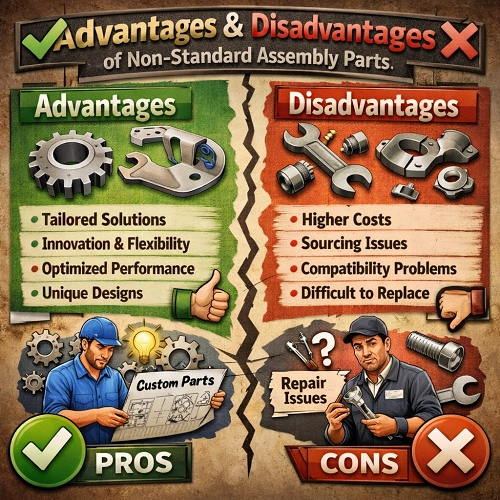
In modern manufacturing and mechanical design, assembly parts form the backbone of virtually every product, from consumer electronics to industrial machinery. While standard parts—like bolts, nuts, gears, and bearings that conform to widely accepted specifications—offer consistency and interchangeability, non-standard assembly parts are increasingly used to meet specific design, performance, or functional requirements. Understanding their advantages and disadvantages is crucial for engineers, supply chain managers, and product developers who must balance innovation, cost, and reliability.
Non-standard assembly parts are components that deviate from conventional specifications, either in terms of dimensions, materials, geometry, or functional properties. Unlike standard parts, which are mass-produced and widely available, non-standard parts are often custom-designed for a particular application. Examples include:
Non-standard parts allow engineers to tailor components to precise functional requirements. For example:
This optimization can lead to higher system efficiency, reduced energy consumption, and improved overall product performance.
In industries such as aerospace, automotive, and robotics, minimizing weight and maximizing space utilization is critical. Non-standard parts can:
This often translates into better fuel efficiency in vehicles, reduced material costs, and improved ergonomics.
Custom parts can be engineered to withstand higher stress, unusual environmental conditions, or corrosive environments. For example:
This improves the longevity and reliability of the final assembly.
In high-tech industries, proprietary parts can provide a competitive edge. By incorporating non-standard components:
This is particularly important in consumer electronics, aerospace, and defense sectors.
Custom parts often require specialized tooling, machining, or additive manufacturing processes, which are significantly more expensive than standard parts. Costs include:
In addition, the need for specialized materials can further increase expenses.
Unlike standard parts that can be sourced globally with multiple suppliers, non-standard parts usually have limited sources. Risks include:
These factors can lead to production delays and higher inventory costs.
Non-standard parts can complicate maintenance and repair processes:
This can result in higher operational downtime and lifecycle costs.
Integrating non-standard parts into larger assemblies can be technically challenging:
Such issues can negate the intended benefits if not carefully managed during design and prototyping.
Since non-standard parts are often unique, they carry a higher risk of obsolescence:
This is particularly relevant in aerospace, defense, and industrial equipment, where products are used for decades.
When deciding whether to use non-standard assembly parts, companies should carefully evaluate:
Non-standard assembly parts offer significant advantages in terms of performance optimization, space and weight reduction, durability, and competitive differentiation. However, these benefits come with trade-offs in cost, supply chain complexity, maintenance, integration, and risk of obsolescence.