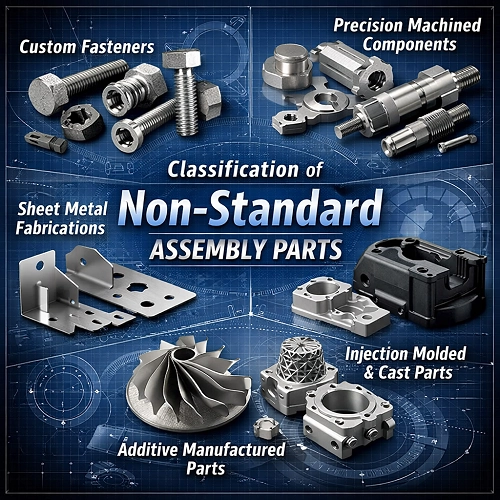
Non-standard assembly parts are components that deviate from internationally recognized standards such as ISO, DIN, ANSI, or JIS. Unlike off-the-shelf parts, they are engineered to meet specific functional, structural, environmental, or aesthetic requirements. These components are widely used in industries such as aerospace, automotive, electronics, medical devices, industrial automation, and heavy machinery.
Non-standard parts are typically developed through close collaboration between design engineers and manufacturing specialists. Their classification is generally based on manufacturing processes, geometry, material selection, and functional role within an assembly.
Custom fasteners are mechanical hardware components designed to join, clamp, align, or secure parts where standard fasteners cannot meet load, spatial, or environmental requirements.
Special fasteners are engineered with modified dimensions, strength grades, materials, or coatings.
For example, in high-vibration environments, fasteners may incorporate prevailing torque features or locking patches to prevent loosening.
Custom threads and head geometries are often required to improve load distribution, prevent tampering, or fit confined installation spaces.
Engineering challenges include maintaining thread tolerances (typically ISO 6g/6H equivalents or tighter) and ensuring compatibility with mating components.
customize machined components are typically manufactured using subtractive processes such as CNC milling, turning, and grinding. These parts are used where dimensional accuracy, tight tolerances, and surface finish are critical.
CNC milling enables complex 3-axis to 5-axis geometries with high repeatability.
Advanced parts may require multi-axis simultaneous machining to reduce setups and improve geometric accuracy.
Turned components are produced on CNC lathes and are typically rotationally symmetric.
Critical parameters include:
Grinding is used for:
Grinding can achieve tolerances within ±0.002 mm and surface finishes below Ra 0.4 µm. It is often a secondary process following heat treatment.
Sheet metal non-standard parts are widely used in enclosures, structural supports, and electronic housings.
Laser cutting offers:
Typical tolerances: ±0.1 mm depending on material thickness.
Stamping is suitable for high-volume production and includes:
Tooling design must account for springback, burr formation, and material grain direction.
Custom brackets and housings are often fabricated through:
Engineering considerations include:
Material selection commonly includes cold-rolled steel, stainless steel, or aluminum alloys, with surface treatments such as powder coating or anodizing.
These components are formed by shaping molten material within a mold cavity, making them ideal for complex geometries and medium-to-high production volumes.
Injection molding is widely used for thermoplastics such as:
Key engineering challenges include controlling warpage, sink marks, and dimensional stability.
Die casting is commonly used for aluminum, zinc, or magnesium alloys.
Typical applications include motor housings, gearboxes, and structural frames.
Additive manufacturing enables layer-by-layer construction of components, allowing unprecedented design freedom.
Used primarily in design validation and testing phases.
Technologies include:
Additive manufacturing is increasingly used for:
Engineering considerations:
Materials range from high-performance polymers (PEEK, ULTEM) to metal powders (AlSi10Mg, Ti-6Al-4V, stainless steel).
Across all categories of non-standard assembly parts, several critical engineering principles apply:
Quality standards such as ISO 9001 or industry-specific certifications (e.g., aerospace or automotive quality systems) are often required.
Non-standard assembly parts play a vital role in enabling innovation and performance optimization across industries. Their classification—custom fasteners, precision machined components, sheet metal fabrications, molded and cast components, and additive manufactured parts—reflects both manufacturing processes and functional requirements.
Understanding the technical characteristics, material behavior, tolerance control, and production constraints of each category allows engineers to select the most appropriate manufacturing route while ensuring structural integrity, cost efficiency, and long-term reliability.