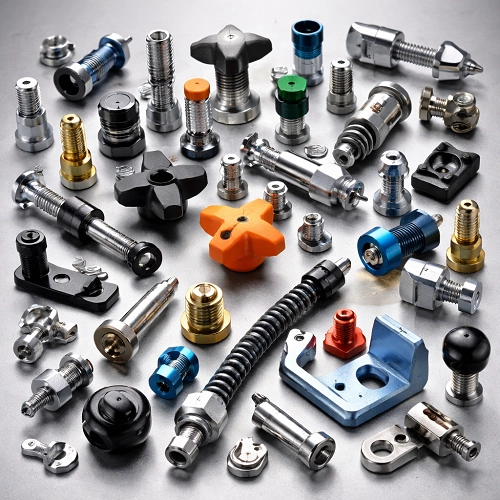
In manufacturing and engineering, the term non‑standard assembly parts refers to components that fall outside the realm of widely used, cataloged, or “off‑the‑shelf” parts. These parts are often tailored for specific applications, unique products, or particular manufacturing requirements. Unlike standard parts—which conform to established industry norms and can be sourced from multiple suppliers—non‑standard parts are custom‑designed and often proprietary.
Standard vs. Non‑Standard: Defining the Difference
Standard Parts
Standard parts are components manufactured according to industry or international specifications such as ANSI, ISO, DIN, JIS, or ASME.
Examples include:
- Bolts, screws, and nuts
- Washers
- Bearings
- Standard gears
- Fasteners and pins
These parts are interchangeable and available from many suppliers.
Non‑Standard Parts
Non‑standard assembly parts are components that:
- Do not conform to established standards,
- Are designed for a specific product or assembly,
- Often have unique geometries, tolerances, or material requirements,
- May be proprietary to a particular manufacturer.
Examples include:
- Custom‑shaped brackets
- Specialized cams, levers, or linkage components
- Unique housings or enclosures
- Custom fasteners or inserts
- Special gaskets or seals
In some industries, terms like custom parts, engineered parts, or specialty parts are used interchangeably with non‑standard parts.
Why Use Non‑Standard Parts?
The decision to use non‑standard parts arises from engineering, functional, or design needs that cannot be met with off‑the‑shelf components.
Functional Requirements
Certain designs require unique shapes, sizes, or functions that standard parts cannot provide, such as:
- Uncommon load‑bearing configurations
- Unique motion profiles
- Specific fitment in constrained spaces
Performance Optimization
Non‑standard parts can be optimized for:
- Weight reduction (e.g., lightweight aerospace components)
- Increased durability under specific stresses
- Thermal or electrical performance tailored to application
Integration
Custom parts may be designed to:
- Integrate multiple functions into a single piece (reducing assembly steps),
- Reduce part count,
- Simplify assembly.
Differentiation
Manufacturers often design unique parts to:
- Protect intellectual property,
- Create product differentiation,
- Prevent aftermarket substitutions.
Types of Non‑Standard Assembly Parts
Non‑standard parts can be categorized by functionality, manufacturing process, or degree of customization:
By Function
- Structural components: Frames, brackets, supports
- Motion components: Custom cams, followers, linkages
- Sealing components: Custom gaskets, O‑rings with unique cross‑sections
- Interface components: Custom connectors, adaptors
By Manufacturing Process
- CNC‑machined parts: Precision metal components
- Casting or forging outputs: Custom shapes produced in molds or dies
- Additively manufactured parts (3D printing): Complex internal geometries
- Sheet metal fabricated parts: Custom enclosures, panels
By Customization Level
- One‑off prototypes: Designed for testing or R&D
- Low‑volume production parts: For specialized machinery
- Mass custom parts: High‑volume but unique to a product line
Engineering and Design Considerations
Designing non‑standard assembly parts requires careful planning.
Key considerations include:
Requirements Capture
- Functional needs: What must the part do?
- Load conditions: Static vs. dynamic loads, fatigue considerations
- Environmental factors: Temperature, corrosion, chemical exposure
Material Selection
Material choice affects:
- Strength and stiffness
- Wear resistance
- Thermal characteristics
- Machinability or formability
Engineers often use advanced materials (e.g., high‑strength alloys, composites, engineered plastics) based on application demands.
Tolerances and Fits
Non‑standard parts often have tight tolerances to meet performance requirements.
Tolerance specification impacts:
- Machining time and cost
- Assembly precision
- Functional performance
Simulation and Prototyping
Modern design workflows incorporate:
- Finite Element Analysis (FEA)
- Computational Fluid Dynamics (CFD)
- Rapid prototyping
These help validate the design before full‑scale production.
Manufacturing Methods
The choice of manufacturing process depends on complexity, quantity, material, and cost.
CNC Machining
- Offers high precision,
- Ideal for metals and high‑tolerance parts,
- Suitable for small to medium runs.
Casting and Forging
- Useful for complex or bulky shapes,
- Requires molds/dies (higher upfront tooling costs),
- Best for medium to large runs.
Additive Manufacturing
- Enables highly complex geometries,
- Reduces material waste,
- Rapid iteration for prototypes or low‑volume runs.
Sheet Metal Fabrication
- Good for panels, enclosures, supports
- Includes laser cutting, bending, stamping
Injection Molding (for plastics)
- High efficiency for large volumes,
- High tooling cost,
- Excellent part repeatability.
Quality Control and Inspection
Non‑standard parts often require enhanced inspection due to unique tolerances:
- Coordinate Measuring Machines (CMMs): For precise dimensional verification
- Optical comparators / laser scanners: For complex geometries
- Surface finish measurements: Ra values, profilometry
- Non‑destructive testing (NDT): Ultrasonic, dye penetrant, radiography
Quality plans are typically developed as part of First Article Inspection (FAI) processes to ensure conformity before full production.
Documentation and Traceability
Proper documentation ensures that non‑standard parts can be reproduced, inspected, and serviced:
- Detailed engineering drawings
- CAD models with version control
- Bills of Materials (BOMs)
- Material certifications
- Inspection reports
Traceability is especially critical in regulated industries such as aerospace, medical devices, and automotive.
Cost Considerations
Non‑standard parts typically carry higher costs than standard ones due to:
- Design engineering time
- Prototype iterations
- Tooling development
- Lower economies of scale
- Inspection and quality assurance
However, these costs are often justified by improved product performance, reduced assembly complexity, or competitive differentiation.
Supply Chain and Inventory Impacts
Non‑standard parts require careful supply chain management:
- Lead times: Custom parts can have longer lead times
- Single‑source risk: Proprietary designs may limit vendor options
- Inventory planning: Balancing availability with cost of carrying unique stock
Vendor partnerships and advanced planning systems (e.g., ERP and MRP) help mitigate risks.
Applications and Industry Examples
Automotive
Custom suspension components, brackets, and engine parts tailored for performance vehicles.
Aerospace
Highly specialized parts like turbine blades, structural components, and custom fasteners with stringent tolerances.
Medical Devices
Implants, surgical instruments, and custom housings designed for patient‑specific needs.
Industrial Machinery
Unique cams, dies, fixtures, and tooling components designed for specific manufacturing lines.
Consumer Electronics
Custom connectors, shielding parts, and housings optimized for form factor and function.
Best Practices for Using Non‑Standard Parts
- Design for Manufacturability (DFM): Engage manufacturers early
- Standardize where possible: Combine custom features with standard elements
- Document thoroughly: Prevent miscommunication and errors
- Plan supply chain ahead: Ensure reliable sourcing
- Control engineering changes: Avoid costly revisions
Non‑standard assembly parts are indispensable in modern engineering, enabling unique product features, optimized performance, and tailored solutions. Their design and production require careful attention to materials, manufacturing methods, tolerances, and quality assurance. While more complex and expensive than standard components, non‑standard parts play a vital role across industries—from aerospace to consumer products—unlocking possibilities that off‑the‑shelf parts simply cannot provide.